Cover storyThe monthly briefing for people who staff automated plants
The humanoid robots are getting job descriptions.
Two of this fall's three humanoid robot announcements came with start dates, and every deployment needs people to install, program, maintain and supervise it. Here is what moved in automation hiring this month, what it means for your team, and what to do about it.
Robot orders
10,989
Robots ordered in North America in Q3, up 24.8% on a year earlier.
A3 · Oct 28, 2026
Machine tool orders
$1.0B
US metalworking machinery orders in September. A record month.
AMT · Nov 9, 2026
Cobots
16.7%
Share of Q3 robot orders that were collaborative robots.
A3 · Oct 28, 2026
US installs
38.4K
Industrial robots installed in the US in 2025, ahead of Japan.
IFR · Sept 24, 2026
01 · Cover story · Humanoids
The humanoid robots are getting job descriptions.
The pilots are turning into schedules. Each one comes with a support team that most plants have not hired yet.
Somebody has to set it up, watch it work and fix it when it stops
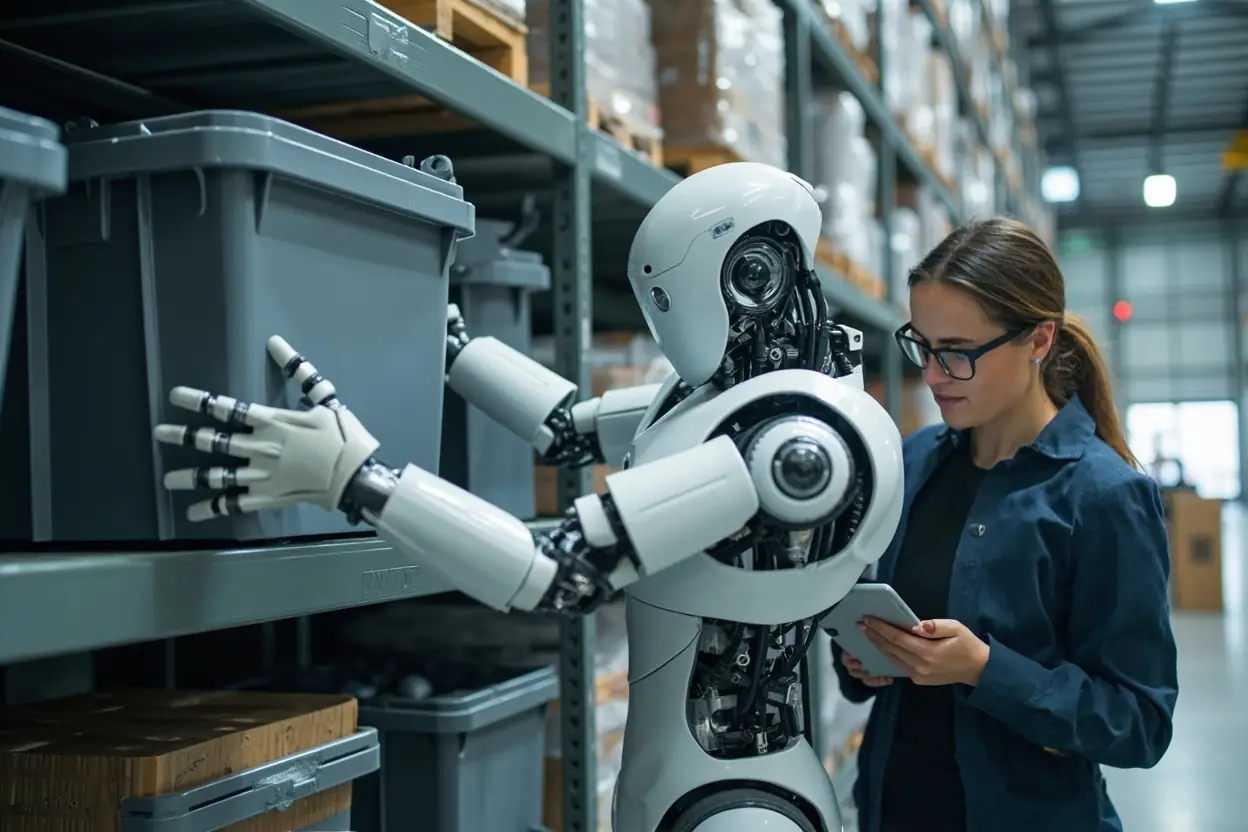
GXO said on October 26 that Agility Robotics' Digit humanoid has moved more than 100,000 totes at its Flowery Branch, Georgia, site, and that the two companies are expanding to additional US sites.
AGCO signed a commercial agreement with Agility on October 20 to pilot Digit at its Hesston, Kansas, plant beginning in 2027, starting with parts sorting, stacking and placing totes for storage.
And on November 12, GXO signed a letter of intent with Apptronik aimed at up to 1,000 Apollo humanoid robots over four years, with the first North American deployment in late 2027. That plan depends on the robots meeting agreed performance and safety targets.
A robot that moves totes all night still needs a person who knows why it stopped at 3 a.m.SourceOwls analysis
Chip and electronics plants nearly doubled their robot orders.
The third quarter was the strongest of the year for robot orders, and the growth came from many industries at once.
North American companies ordered 10,989 robots worth $723.5 million in the third quarter, the Association for Advancing Automation reported on October 28. That is up 24.8% in units and 26.1% in value from a year earlier.
Semiconductor and electronics plants raised their orders 97.6%, and automotive component suppliers 90.4%. Car makers themselves returned to growth at 7.5%, though they remain 17% below last year for the first nine months. Food and consumer goods fell 23.7%.
These are North American orders, not US installations. They are a leading signal: a robot ordered this fall is a cell that needs integration, programming and maintenance staff next year.
Which industries ordered more robots, and which ordered fewer
Change in robot units ordered, Q3 2026 against Q3 2025, North America, A3
Machine tool orders just set a record. Someone has to run them.
US shops ordered more metalworking machinery in September than in any month on record.
A record month for machine tool orders
US metalworking machinery orders, millions of dollars, AMT USMTO
Sept 2025$499.3M
Aug 2026$730.1M
Sept 2026$1,007.3M
Orders of metalworking machinery reached $1,007.3 million in September, AMT reported, 101.7% above September 2025 and 22.5% above the previous monthly record set in December 2025. The count of machines ordered was the highest since September 2014.
Orders for the first nine months of 2026 reached $5.76 billion, 45.0% above the same period of 2025, and September was the seventh straight month above half a billion dollars. AMT credits a growing appetite for automation among the companies buying.
The Census Bureau saw the same direction: new orders for machinery rose 1.2% in September.
Every machine on order needs installation, controls work, programming and an operator who can keep it running. Hiring for those seats takes longer than shipping the machine.
Robots that take spoken instructions still need someone to check the work.
Programming a robot is getting easier. Proving the program is safe and correct is not.
Collaborative robots, built to work near people, made up 16.7% of North American robot units ordered in the third quarter: 1,831 units, about 56% more than a year earlier, according to A3.
At PACK EXPO in Chicago this fall, FANUC demonstrated one of its collaborative robots taking natural language requests. Generative AI turned those spoken instructions into Python code and robot actions.
That lowers the bar to get a robot moving. It raises the value of the person who can read the generated code, test the cell, keep the safety interlocks intact and recover from a fault. That person is a controls technician, and they are already scarce.
The robot writes the first draft. A technician signs off on it.
Community colleges just got $65 million to train technicians.
The newest round of federal college grants names robotics, automation and mechatronics technicians among its targets.
Short programs, built with employers, aimed at your open seats
The Labor Department announced $65 million in Strengthening Community Colleges grants on September 23. This sixth round funds short, high quality programs in high demand sectors, built to qualify for Workforce Pell funding.
Advanced manufacturing is one of the named sectors, and the funded projects list occupations such as robotics and automation technicians, mechatronics and automation technicians, and industrial maintenance technicians.
Grant money goes to the college, not to employers. What an employer can offer is input on the curriculum, equipment time and a job at the end. That is how a program ends up teaching the controls platform you actually run.
The US became the second largest market for industrial robots in 2025, behind only China.
Installations
38,400 robots in 2025
US installations rose 12% in 2025, passing Japan's 36,200, the International Federation of Robotics reported. It was the third strongest year on record.
Fastest growth
Food and beverage up 30%
Food and beverage plants installed 2,900 robots. The automotive industry remained the largest customer at 13,500.
Growth came from food, warehousing, logistics and medical
Rockwell Automation's fiscal 2026 sales reached $8,989 million, up from $8,342 million. Its chief executive said the company enters fiscal 2027 with healthy customer demand, as industrial operations become more AI enabled and autonomous.
Tax timing
The 2026 Section 179 limit is $2.56 million
For tax years beginning in 2026, the IRS allows a Section 179 deduction of up to $2,560,000, reduced once qualifying equipment placed in service tops $4,090,000. Ask your tax adviser how it affects when new cells go live, and when their technicians need to start.
Three questions to bring to your next staffing meeting.
Ownership
Who is responsible for robot uptime on second shift?
No name means the answer is whoever is closest. That is not a plan.
Timing
When does our next cell go live, and when does its technician start?
The person should arrive before the machine, not after it.
Bench
Which of our maintenance people could become controls technicians in a year?
Training someone who knows your plant is usually faster than finding someone who does not.
Have a controls, robotics or mechatronics seat that has stayed open too long? Run it through the SourceOwls Hiring Desk: local pay for the role, where your offer sits, and what to do about it this week. Free, and no email needed.